An Integrated Platform for Governance, Risk & Compliance
GRC Orbit empowers organizations to unify governance, risk, compliance, and cybersecurity management within a connected digital environment — supporting compliance, strengthening oversight, and enabling more effective decision-making.
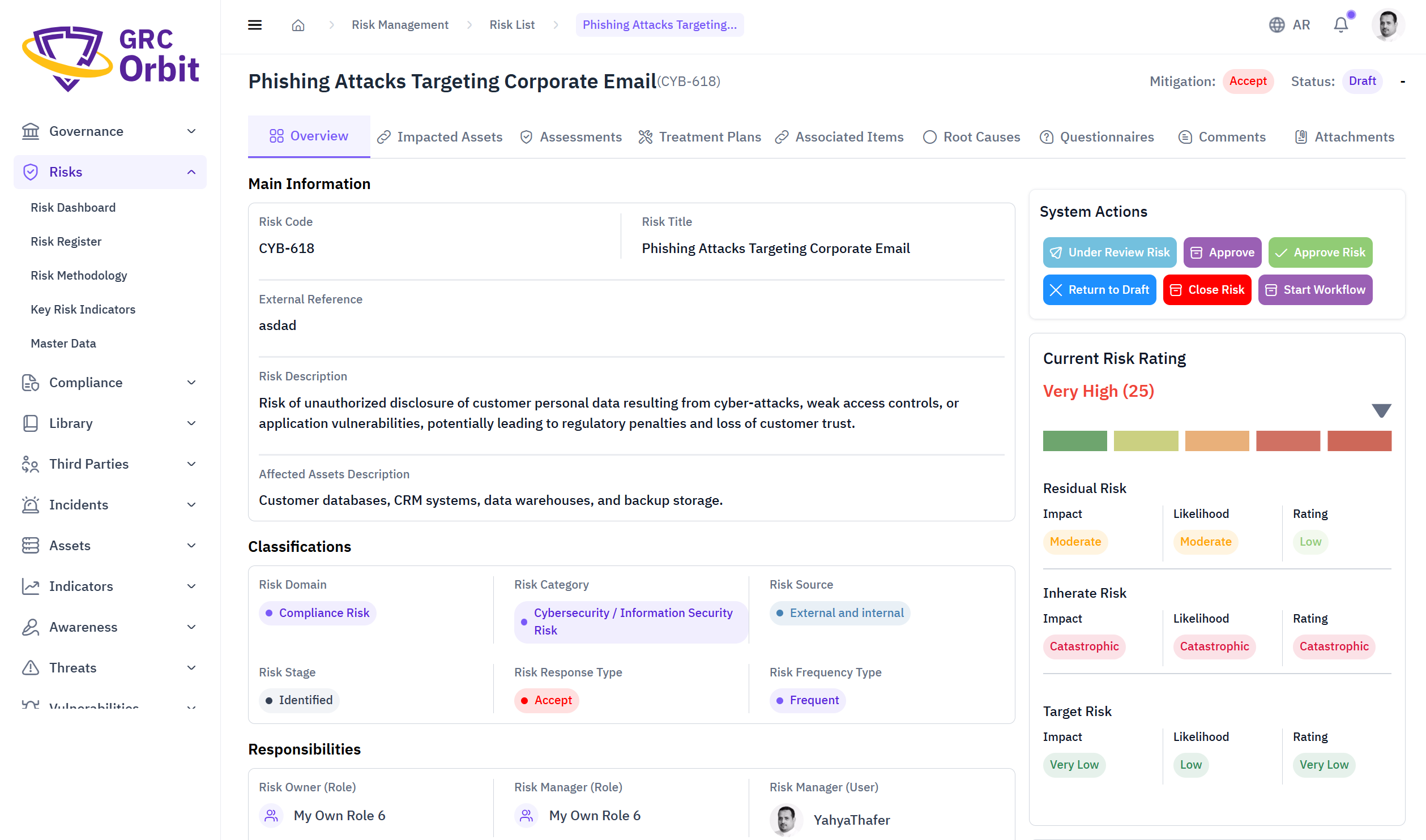
From Fragmented Challenges to a Connected, Measurable GRC Program
Organizations today face growing challenges in unifying governance, managing risks, addressing vulnerabilities, proving compliance, and ensuring business continuity. GRC Orbit transforms these challenges into clear operational capabilities through a single platform that connects data, automates workflows, and gives senior management an executive view to make faster, more confident decisions.

Challenge: Weak Integration Between Governance, Risk, and Compliance
In many organizations, governance, risk, and compliance are managed as separate tracks: policies in one place, risks in isolated files, controls in spreadsheets, and evidence scattered across departments. This fragmentation forces senior management to rely on delayed, disconnected reports — making it difficult to see the true picture of the organization's posture.
Solution with GRC Orbit: The platform provides a unified model connecting strategy, policies, controls, risks, tasks, and reports in one place. Senior management can see the relationship between a decision and a policy, between a control and its associated risks, and between actual compliance and the evidence that proves it. This integration transforms GRC from a documentation activity into a leadership system that improves oversight, raises transparency, and identifies weaknesses before they become operational or regulatory gaps.
Challenge: Policies Exist but Their Implementation Cannot Be Measured
Many organizations rely on written and approved policies but lack an effective mechanism to know whether they have been published, understood, applied, reviewed, and linked to controls and regulatory requirements. Over time, policies become static documents that no longer reflect operational reality.
Solution with GRC Orbit: The platform manages the full policy lifecycle — from drafting, review, and approval to publication, awareness, and periodic review. It also links each policy to related controls, requirements, risks, evidence, and action items. Policies become a living part of the governance ecosystem, and management can see which policies are active, which are overdue for review, their compliance levels, and the gaps requiring corrective action.
Challenge: Risks Are Logged but Not Managed Proactively
One of the biggest challenges is risk registers becoming static lists that never lead to decisions or actions. A risk may be assessed once, then remediation is never followed up — or the risk is never linked to controls, assets, third parties, incidents, or KPIs and KRIs.
Solution with GRC Orbit: The platform provides integrated management of the full risk lifecycle — from identification, classification, and assessment through owner assignment and treatment plans, to tracking, closure, or acceptance. It links risks to controls, vulnerabilities, third parties, and business continuity so risks are never isolated from operational reality. Senior management can monitor critical and overdue risks, exposure levels, and treatment plans through clear indicators that support decision-making.
Challenge: Too Many Vulnerabilities, Too Hard to Prioritize
Vulnerability scanning tools can produce large volumes of findings, but the real problem is not just detection — it's knowing which vulnerabilities must be addressed first, who is responsible, and how they relate to critical assets and organizational risks.
Solution with GRC Orbit: The platform supports vulnerability management from discovery through closure, with integration capabilities for scanning tools such as Nessus and others. Vulnerabilities are classified and linked to assets, severity levels, exploit likelihood, operational impact, and remediation plans. They can also be linked to risks and controls, enabling security teams and management to shift from ad-hoc remediation to structured, priority-driven treatment based on real organizational impact.
Challenge: Third-Party Risks Outside Full Visibility
Vendors, partners, and service providers can pose significant operational, regulatory, and cybersecurity risks. Yet they are often managed through one-time assessments with no ongoing follow-up and no clear link between a third party's risk level and the services, data, or processes that depend on them.
Solution with GRC Orbit: The platform provides comprehensive third-party lifecycle management — from registration, classification, and assessment through questionnaires, obligation reviews, risk tracking, and corrective action management. Each third party can be linked to related services, contracts, assets, controls, and risks, giving management clear visibility into the highest-risk vendors, critical dependencies, and gaps that could affect business continuity or compliance.
Challenge: Business Continuity Plans That Are Outdated or Untested
Some organizations have business continuity plans but don't know with certainty whether they are actionable during a crisis, whether they have been tested, or whether they meet recovery objectives such as RTO and RPO. This creates a gap between documentation and actual readiness.
Solution with GRC Orbit: The platform helps manage business continuity scenarios, recovery plans, response teams, tests, outcomes, and lessons learned. It links continuity plans to risks, critical processes, third parties, assets, and escalation procedures — enabling management to know the true state of readiness, which plans need updating, which tests have not been run, and which gaps could affect the organization's ability to operate during a crisis.
Challenge: Difficulty Complying with Multiple, Evolving Frameworks
Organizations don't deal with just one framework — they manage multiple requirements including national standards, ISO, cybersecurity regulations, sector-specific mandates, and internal policies. The biggest challenge is duplicated controls, differing terminology, and changing requirements, leading to enormous effort in assessment and follow-up.
Solution with GRC Orbit: The platform provides a central repository for frameworks, requirements, and controls, with the ability to map similar requirements to unified controls to reduce duplication. Assessing a single control can reflect across multiple linked frameworks or requirements. The platform also tracks compliance status, identifies gaps, creates treatment plans, and presents compliance levels per framework — independently or consolidated — for senior management.
Challenge: Difficulty Collecting Evidence During Audits
During audits, teams get lost in emails, shared files, different versions, and repeated evidence requests. This consumes enormous time and increases the likelihood of submitting outdated or irrelevant evidence not directly linked to the required control or requirement.
Solution with GRC Orbit: The platform provides a central evidence library linked to controls, requirements, assessments, policies, and tasks. Evidence owners, update dates, review statuses, and validity periods are all trackable. When an audit begins, the team can quickly access required evidence, identify missing items, and manage update or approval requests from within the platform — reducing manual effort, raising evidence quality, and increasing auditor confidence in the maturity of the compliance program.
Unified Compliance with Saudi and International Frameworks in One Platform
Organizations in the Kingdom face a growing array of regulatory requirements spanning cybersecurity, data governance, privacy, the financial sector, and digital transformation. GRC Orbit provides a unified environment to manage these frameworks, link requirements to controls, reduce duplication, collect evidence, and track audit readiness — all from one place.
National Cybersecurity Authority (NCA)
Manage cybersecurity controls such as ECC and CSCC, linking them to risks, assets, vulnerabilities, remediation plans, and evidence to ensure continuous readiness for measurement and compliance.

Saudi Central Bank (SAMA)
Support governance, risk, and cybersecurity requirements in the financial sector through periodic assessments, compliance indicators, and treatment plans linked to responsibilities and evidence.

Capital Market Authority (CMA)
Enable regulated entities to manage governance, disclosure, risk management, and internal control requirements within a trackable and auditable institutional framework.
Communications, Space and Technology Commission (CST)
Support telecommunications services and digital infrastructure regulatory requirements by linking technical obligations to controls, risks, service providers, and operational evidence.
National Data Management Office (NDMO)
Manage data governance, data quality, classification, sharing, retention, and privacy requirements, linking them to organizational policies, data owners, and compliance evidence.

Saudi Data and Artificial Intelligence Authority (SDAIA)
Support compliance with data, AI, and personal data protection policies, tracking controls, consents, risks, and data subject requests.

Digital Government Authority (DGA)
Enable entities to track digital transformation indicators, service maturity, digital governance, and initiative readiness through clear measurement and auditable documentation.

ISO 27001
Manage the information security management system by linking controls to risks, policies, assets, evidence, improvement plans, and internal and external audit findings.
NIST Framework
Align cybersecurity capabilities with the Identify, Protect, Detect, Respond, and Recover functions, linking them to risks, vulnerabilities, and improvement plans.
GDPR / Privacy
Manage privacy and personal data protection requirements through a processing records register, consents, data subject rights, risks, and data breach incidents.
HIPAA
Support healthcare data protection and privacy requirements in the medical sector by linking controls to policies, access, evidence, and operational risks.
DoD / CMMC
Manage cybersecurity requirements for sensitive environments and defense supply chains, tracking maturity, gaps, evidence, and remediation plans.
System Modules
GRC Orbit modules work independently or in an integrated manner — click on any module to explore it.
Designed for Saudi Sectors, Flexible for Every Organization's Needs
In the Saudi market, governance, risk, and compliance are no longer just regulatory requirements — they have become an essential part of digital transformation, data protection, advancing cybersecurity maturity, and improving service efficiency. GRC Orbit provides a unified platform that helps every sector manage its regulatory and operational requirements in a connected, measurable, and audit-ready manner.

Government Sector
GRC Orbit serves government entities by unifying governance, cybersecurity, data governance, and digital transformation requirements in a single platform. The system helps manage NCA, NDMO, SDAIA, and DGA requirements by linking policies to controls, controls to evidence, and evidence to assessments and improvement plans. Government entities can track compliance levels, measure maturity, manage institutional risks, and document readiness for national benchmarks and internal and external audits. The platform also supports digital transformation teams in building a unified view of services, risks, data, stakeholders, and performance indicators — enhancing transparency and improving decision-making efficiency.

Financial and Banking Sector
GRC Orbit provides financial and banking institutions with an integrated environment for managing governance, operational risk, cybersecurity, compliance, and third-party risks. The system helps align SAMA and CMA requirements with daily operations through periodic assessments, treatment plans, maturity indicators, and auditable evidence. It also enables senior management to track critical risks, compliance status, control readiness levels, and gaps that could affect operational stability or regulatory trust. Through automation and executive reporting, compliance becomes a continuous process rather than a seasonal activity before audits.

Insurance Sector
GRC Orbit supports insurance companies in managing a regulatory and operational environment that depends on precision, oversight, and continuous risk management. The system links operations, claims, fraud, third-party, business continuity, and regulatory compliance risks — giving management and oversight teams a broader view of exposure sources and areas requiring improvement. It also helps manage policies, controls, assessments, and evidence in a unified manner so compliance can be tracked, procedure effectiveness measured, and clearer regulatory and executive reports prepared. This makes risk management in the insurance sector more connected to actual operations, not just isolated records.

Telecommunications and Technology Sector
GRC Orbit serves the telecommunications and technology sector by connecting cybersecurity, vulnerability management, technical risks, compliance, and service providers in a single ecosystem. The system helps align CST and NCA requirements with technical assets and digital services, enabling tracking of controls, vulnerabilities, incidents, remediation plans, and evidence through a clear operational view. It also supports technology organizations in protecting digital infrastructure, improving risk response speed, and managing regulatory obligations related to services, data, and service providers. Compliance and security thus become part of digital service operations, not a separate layer.

Military and Defense Sector
GRC Orbit provides military and defense sectors with a rigorous model for managing security controls, risks, vulnerabilities, third parties, and sensitive supply chains. The system supports the application of advanced security frameworks such as NIST and CMMC, with the ability to link requirements to sensitive assets, systems, policies, evidence, and remediation plans. It also helps defense entities enhance readiness, unify oversight, and track compliance across multiple levels of classification and operational sensitivity. Through centralized documentation and approved workflows, security governance can be elevated and reliance on manual follow-up reduced in high-sensitivity environments.
Smart Investment, on Terms That Suit You
Don't pay more than you need, and don't wait to get started. Our flexible business model puts your actual needs first — modules you choose, plans that fit your budget, and a fast, obstacle-free launch.

Trusted Vision
A consulting company providing integrated services, solutions, and training in governance, risk management, and compliance to help organizations meet their business requirements and achieve compliance.
Ready to See GRC Orbit Working for Your Organization?
Book a personalized demo for your organization — we'll show you how the system works with your actual data and real requirements.
We help you select the most suitable features for your organization and build a phased or fully integrated implementation journey based on priority.